
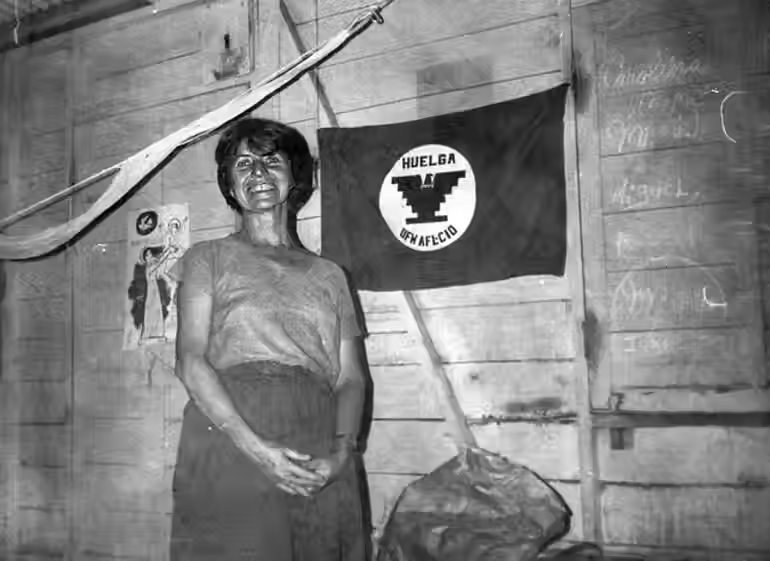
Carole Harper was born in Mobile, Alabama, on February 26, 1942. She grew up in a traditional Catholic family alongside her parents and her brother. Racism marked her childhood and, in many ways, shaped her life’s purpose. Mobile is a port city that flourished on the slave trade during the 18th and 19th centuries; Carole witnessed the lasting impact of that history as she grew up.
At age 18, she moved to New York. Then, she studied law at the University of San Francisco, California, specializing in social administration. In her early years as a professional, she worked in legal services and anti–poverty law, supporting rural farmworkers in Coachella, California.
In the early ’80s, she joined Habitat for Humanity and traveled to Guatemala, where she learned Spanish. In 1984, she arrived in Nicaragua to support the Sandinista People’s Revolution. Her family and closest friends thought she was “crazy” to move to a country at war, but Carole didn’t hesitate:
“I learned that land was being redistributed to the campesinos. I heard that 60,000 young people went into the countryside to teach adults how to read, and that the government was building schools in villages which had no schools, and health centers were giving out free vaccines so kids could finally be inoculated. I saw that this was a brilliant moment and I thought, ‘Sign me up! This is everything I ever believed in.’”
Habitat for Humanity – Wellspring Center and El Porvenir
Carole began as a volunteer with Habitat for Humanity; the first houses were built in the Germán Pomares neighborhood of Chinandega. Under Carole’s vision, Habitat delegations worked alongside communities, visited schools and health centers to understand local needs, and helped dispel misinformation coming from the US about a lack of freedom in Nicaragua. She eventually became the national director.
Carole was struck by the fact that families lacked electricity and running water.
That’s when she dedicated herself to access to water and sanitation:
“My dream is for no woman to have to carry water on her head,” she would repeat countless times in the field.
While leading Habitat’s work, Carole founded Wellspring Center—the original name of El Porvenir. Wellspring grew directly out of Habitat projects, working with rural Nicaraguans to build community wells, washing stations, and even private bathing areas, always prioritizing rural women. Later they introduced rope pumps for hand-dug, lined wells.
Word spread quickly, and communities began requesting El Porvenir’s support, prompting Carole to formally establish El Porvenir. For 18 years, she led El Porvenir, transforming the lives of thousands of rural families and forging an impressive synergy with them. She also loved gallo pinto, nacatamales, and arroz a la valenciana.
On more than one occasion campesinos showed their affection by gifting her a live chicken, one of whom she named Esmeralda and kept as a pet for years. Friends and colleagues remember her as sensitive, empathetic, and fiercely determined.
Carole: Judge and Board President
In the 1990s, Carole moved back to California, where she worked as a judge while continuing her role with El Porvenir as President of the Board of Directors, serving until 2007. She returned to Nicaragua in 2004 when she adopted her son, Mauricio, and in August 2008, they moved to the United States so he could pursue his education.
She said, “I am proudest of the fact that El Porvenir has been ‘Nicaraguanized.’ When we first started the organization, the only employees were short-term North Americans. But gradually, El Porvenir became a Nicaraguan organization, which is how it should be.
That’s one of the reasons why El Porvenir is so successful. We hire local Nicaraguans who know the area and the people, who stay with El Porvenir long-term and give them the chance to flower.”
Carole Harper remained an Emeritus Board member and a key advisor to the organization until her final day on May 22, 2026.


OUR HISTORY
Since 1990, El Porvenir has worked side-by-side with rural families and schools in Nicaragua to construct wells, water systems, latrines, school hand-washing stations as well as support watershed restoration projects.
Carole Harper, a judge in California, founded El Porvenir in 1990 after working with Habitat for Humanity in Nicaragua. She launched El Porvenir to address the lack of clean drinking water in rural communities and respond to the determination of local people to improve their living standards.
El Porvenir grew into an integrated program that includes water, sanitation, hygiene and maintenance education, and watershed restoration. When El Porvenir started offering service trips, Nicaragua was recovering from the aftermath of a civil war and didn’t have a tourism industry; it was difficult to find English-speaking guides, public transportation, or hotels outside of Managua. For North Americans to travel to Nicaragua and see El Porvenir’s rural development work firsthand, it was necessary for El Porvenir to serve as a tour organizer. Service trips bring small groups of North Americans into rural areas to experience village life and work alongside local families on projects.
What was once an organization with one employee, carrying out four projects a year, has become a leading international nonprofit with a mainly Nicaraguan staff partnering with thousands of Nicaraguans annually.